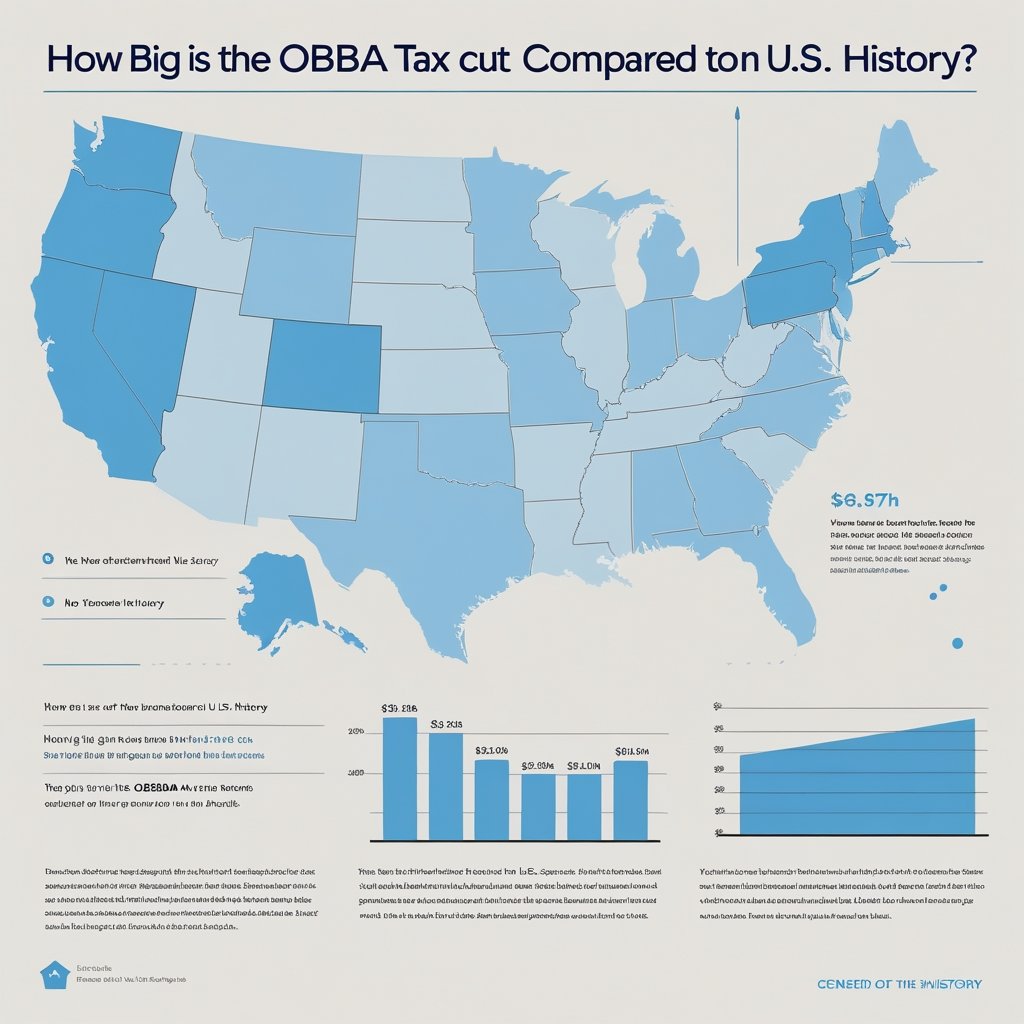
The OBBBA (often referenced in political discussions as a major tax reform proposal) has sparked a nationwide debate: Is it really one of the largest tax cuts in American history?
While headlines often exaggerate for political points, the true size of any tax cut can only be measured by comparing it to past landmark reforms—some of which dramatically reshaped the U.S. tax system.
In this article, we break down what the OBBBA tax cut means, how it stacks up against major tax cuts of the past, and what it could mean for individuals, families, and businesses.
What Is the OBBBA Tax Cut?
The OBBBA is designed to reduce taxes for middle-income families and small businesses by adjusting tax brackets, offering new credits, and modifying deduction thresholds.
Key highlights include:
- Lower tax rates for low- and middle-income earners
- Increased standard deduction
- Additional credit enhancements for families
- Incentives for small businesses and LLCs
- Potential changes in capital gains or corporate tax treatment (depending on final version)
While the proposal has gained popularity, its scale is often overstated. To understand its true impact, we must compare it to the largest tax cuts in U.S. history.
Largest Tax Cuts in American History: A Quick Look
Here are the historical benchmarks experts use when determining the scale of a tax cut:
- The Reagan Tax Cuts (ERTA, 1981)
- One of the most significant in modern history
- Reduced individual income tax rates by 25% across the board
- Major supply-side reform
- Long-lasting impact on federal revenue structure
- Bush Tax Cuts (EGTRRA, 2001 & JGTRRA, 2003)
- Large reduction in income tax rates, especially for higher earners
- Expanded child tax credit
- Cuts to capital gains and dividends taxes
- Massive effect—some estimates place it among the largest cuts ever
- Trump Tax Cuts (TCJA, 2017)
- Reduced the corporate tax rate from 35% to 21%
- Increased standard deduction nearly doubling it
- Expanded child tax credit
- Placed caps on state and local tax (SALT) deductions
Many economists consider the TCJA one of the most significant individual and business tax reforms since 1986.
Where Does the OBBBA Compare?
So how does the OBBBA match up with these historic tax cuts?
- Scale of Revenue Reduction
- Reagan, Bush, and Trump tax cuts each reduced federal revenue by hundreds of billions to trillions over 10 years.
- Early estimates suggest the OBBBA would result in a smaller overall revenue impact than these major reforms.
- Breadth of Reform
- The OBBBA focuses primarily on middle-class tax relief.
- It does not include dramatic across-the-board rate cuts like ERTA (1981).
- It does not cut corporate tax rates at the scale of TCJA (2017).
- Duration
Many provisions in OBBBA are temporary, similar to the Bush tax cuts, meaning they may not have long-term structural impact.
Does That Mean the OBBBA Is Not “The Largest”?
Correct—it is substantial but not comparable in size to the biggest tax cuts in U.S. history.
Instead, the OBBBA is best described as:
✔ A targeted tax cut
Focused on middle-income earners, families, and small business owners.
✔ A moderate reduction in federal revenue
Far smaller than the sweeping cuts from the 1980s, early 2000s, or 2017.
✔ A financially strategic proposal
Designed to encourage consumer spending and support small businesses rather than overhaul the federal tax structure.
How the OBBBA Could Affect You
Here’s what individuals and businesses may experience under the OBBBA:
For Individuals & Families
- Lower income tax burden
- Larger deductions or credits
- Increased take-home pay
For Businesses (Especially LLCs & Small Firms)
- Improved cash flow
- More favorable deductions
- Possible expansion incentives
- Better ability to reinvest in the business
For more Info : Contact us: +1 (972)-996-6644
Email us : info@theriwa.com Visit our website : https://theriwa.com/